Materials guide
Porcelain
Maker
Who makes this material
Porcelain — sintered stone — surfaces are a dense material produced at high temperature and pressure from natural minerals and ceramic raw materials. During production the material is sintered, producing an extremely dense structure with minimal porosity.
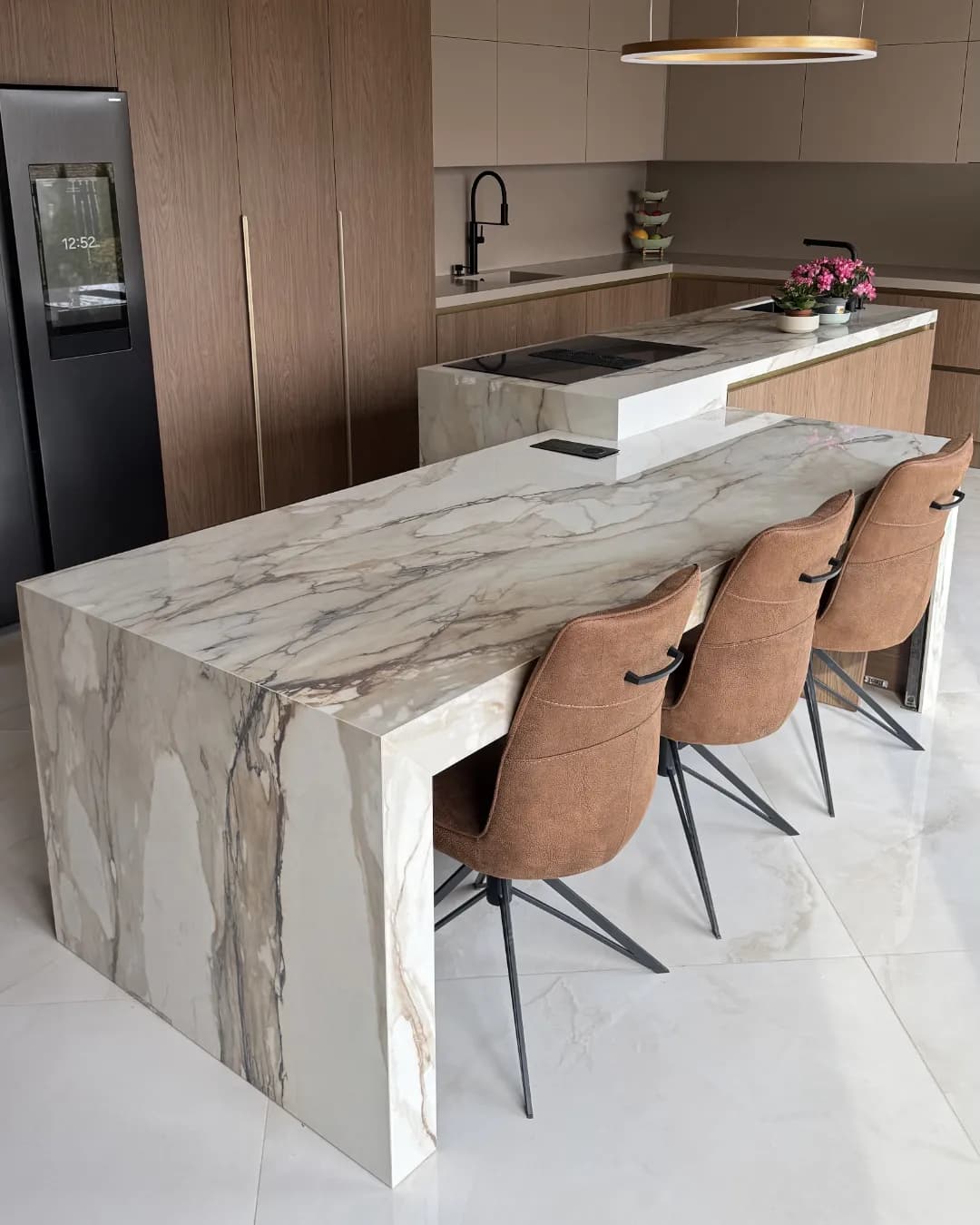
Unlike the traditional porcelain tiles familiar from smaller formats, these surfaces are produced in large slabs of roughly 3200 × 1600 mm. That allows the material to be used for large uninterrupted surfaces with a minimal number of joints — kitchen worktops, islands, walls and furniture.
Porcelain surfaces are exceptionally resistant to heat, UV radiation, moisture, scratching and everyday wear. They therefore suit not only interiors but outdoor applications as well — façades, terraces and steps.
VIA Stone Processing currently represents three porcelain and sintered-stone brands: Dekton, Caesarstone Porcelain and Keralini. Each has its own choice of collections, designs and technical solutions, but all three share the possibility of using large-format porcelain slabs across interior and architectural projects.
In the catalogue
Porcelain in our catalog
Open a slab to see it up close — thicknesses, finishes and price.
0105
At a glance
Benefits and drawbacks
Key advantages
Heat resistance
The material withstands high temperatures and suits kitchens and other zones where the surface may meet hot objects.
UV and weather resistance
Porcelain surfaces are suitable for use outdoors. They are resistant to UV radiation and frost.
Low porosity
The dense structure means very low absorption of water and other liquids. The surfaces are easy to clean and suitable for wet rooms as well.
Resistance to scratches and wear
The material suits intensively used surfaces and keeps its look under everyday load.
Large format
Slabs of roughly 3200 × 1600 mm allow large surfaces with fewer joints. That matters especially for kitchen islands, walls and other broad surfaces.
Wide design possibilities
Modern production technology can produce detailed interpretations of marble, natural stone, concrete and other materials.
Things to note
- Porcelain surfaces are very hard, and it is exactly that property that makes them technically harder to fabricate. Cutting, drilling, edge work and cut-outs must be done with the right professional equipment.
- Correct transport, fabrication and installation of the slab matter especially. Durable as the material is, its edge can be more sensitive to hard point impacts. The construction, the cut-outs, the edge shape and the installation are all a substantial part of the final result.
Keep exploring


