Materials guide
Quartzite
Quartzite is a natural metamorphic stone formed from sandstone over millions of years of heat and pressure. In that process the quartz grains fuse together, producing an exceptionally dense, hard stone. Unlike quartz composites, quartzite is not industrially mixed with resins to achieve a particular look. Its colour, structure and pattern are set by the minerals and the geological processes at work as the stone formed.
Quartzite's hardness is usually around 7 on the Mohs scale, making it one of the most durable natural stones used in interiors. It stands up well to heat, daily wear and scratching, so it suits kitchen worktops, islands, bathrooms, wall cladding, stairs and other intensively used applications.
What makes quartzite special
One of quartzite's greatest values is that every slab is unique. The stone's veining, mineral concentration, colour transitions and crystalline structure formed in nature, and one slab can never be fully repeated in another.
That matters especially for large projects. Even within one and the same stone name, slabs can differ in tone, vein intensity and structure. These differences are not a defect — they are a defining trait of natural stone.
Some quartzites also show natural micro-fissures, open veins or small voids. They can be filled during fabrication, though in some cases these structures may remain visible in the finished piece. It is exactly these details that often give the stone its natural depth and character.
At a glance
Benefits and drawbacks
Benefits
High hardness
Quartzite is highly resistant to scratches and everyday wear, making it well suited to intensively used surfaces.
Heat resistance
Because the material is natural stone and carries none of the resin binder that runs through quartz composites, it is particularly well suited to places where high temperatures are likely.
A natural pattern
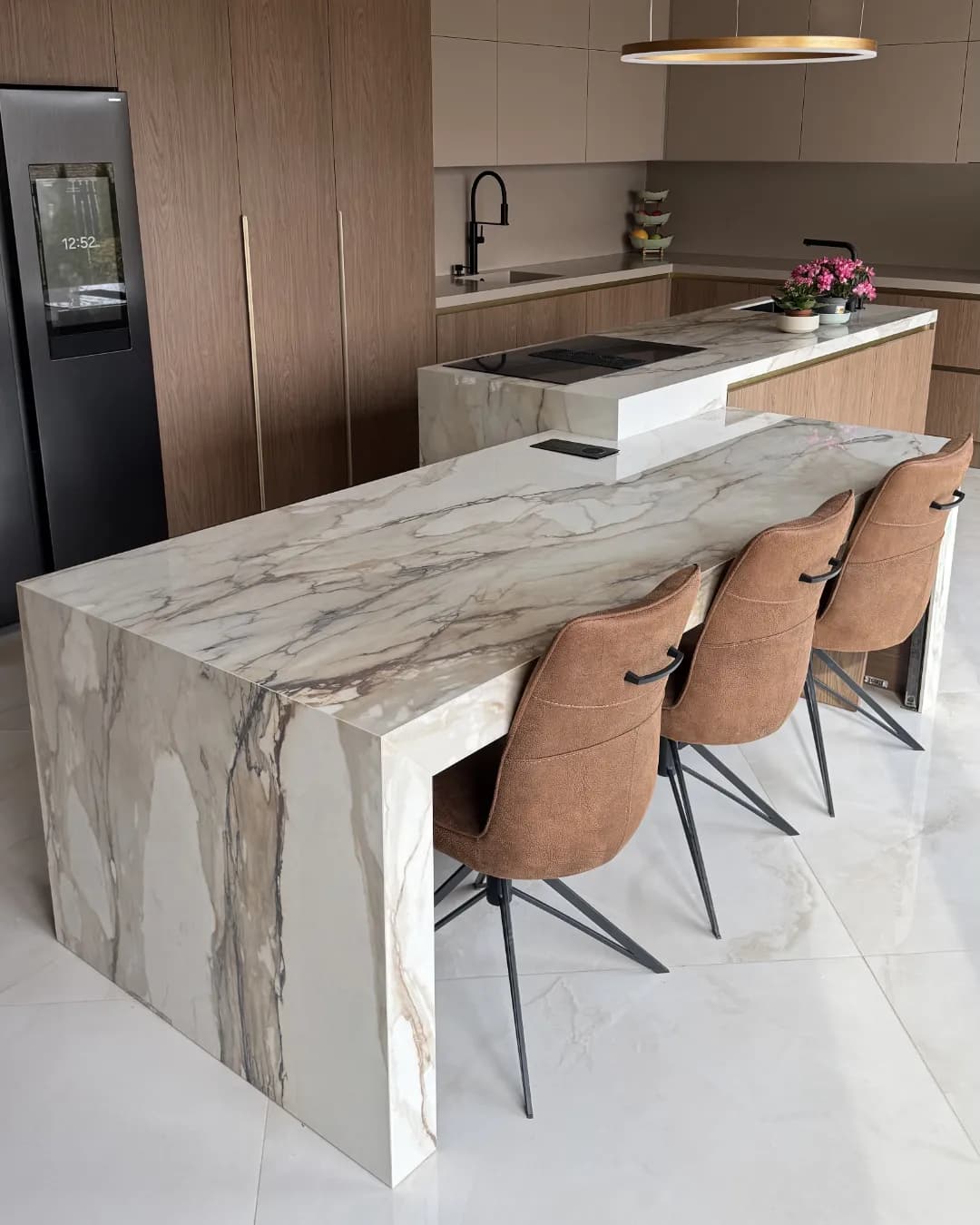
Every slab's structure is unique. Some quartzites look remarkably like marble while offering far higher hardness and resistance to daily wear.
Longevity
Correctly chosen, fabricated and cared for, quartzite can serve for a very long time without losing its natural look.
Things to note
- Quartzite is not a completely non-porous material. Depending on the structure and density of the particular stone it can absorb liquids, so the surface usually needs sealing. Sealing does not make the stone fully impermeable, but it helps reduce the absorption of stains and liquids. How often it needs renewing depends on the particular stone and the protective product used.
- It is also important to assess the actual slab rather than just the stone's name or a small sample. Within one material name there can be substantial differences between slabs, and pronounced veins, mineral concentrations or micro-fissures are part of natural stone's structure.
- Quartzite's hardness also means the material is less forgiving. A hard knock, especially near cut-outs or a slab edge, can chip the edge, which is why sound construction and professional fabrication matter.
Keep exploring


